
A UK industry built for frictionless EU trade
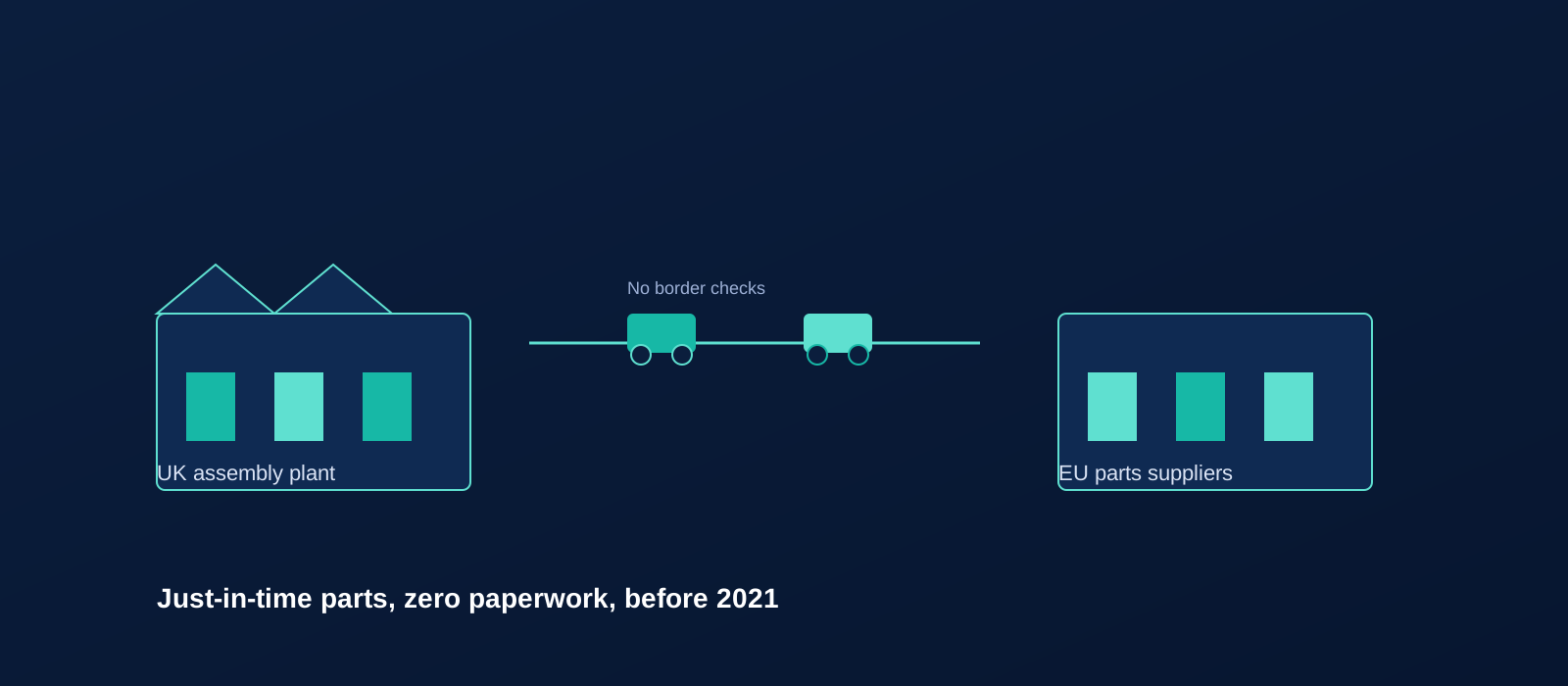
Before Brexit, the UK automotive sector ran on tight EU integration. In 2022, UK plants produced 775,014 cars, 101,600 commercial vehicles, and 1.5 million engines, according to the Society of Motor Manufacturers and Traders. The sector employed 182,000 people directly in manufacturing and 780,000 across the wider industry, and brought in £77 billion, a tenth of all UK exports. Manufacturers like Jaguar Land Rover, Nissan, Toyota, and BMW's Mini plant built factory lines around parts crossing the English Channel with no border checks and no paperwork.
What changed once the UK left the EU
New customs formalities and rules-of-origin requirements replaced that frictionless setup. Reconstructed ONS trade data shows the UK-EU trade index sitting near 100 from 2016 through 2020, then dropping to 52 in 2021 before climbing back to 80 by 2023. That is still a 20-point gap three years after the fall. Investors reacted too: the number of automotive and parts companies listed on the London Stock Exchange fell from an index of 100 in 2004 to 65 by 2021, with the steepest drop coming right after the 2016 referendum.

How manufacturers adapted, and where the industry goes next
The UK signed 38 active free trade agreements after Brexit, including the UK-Japan Comprehensive Economic Partnership Agreement on 31 December 2020, which keeps car tariffs at zero between the two countries. That gave Toyota and Nissan a path to keep their UK plants competitive. The next battleground is batteries: the global stock of electric and hybrid vehicles grew from an index of 1 in 2005 to 520 by 2022. The UK still runs only one battery plant, next to Nissan's Sunderland factory, against 35 operating, under construction, or planned across the EU. Where R&D investment lands next will decide whether the UK keeps its seat at the table.
Sources: SMMT (2023), Office for National Statistics, London Stock Exchange, UK Government trade data. Full dataset and methodology in the Brexit-and-the-UK-Car-Industry repo on GitHub.