Product Owner
Apr 2026 - Present · 4 mosShaping the roadmap for an AI-powered book recommendation platform, turning data on reader behavior into product decisions and feature priorities.
Marketing Data Analyst - Data Strategy for International Expansion
Data is more than numbers. It is the language behind industries, markets, human behavior, and decision-making. My work turns complex datasets into strategic insight, helping organizations see their market clearly and make smarter decisions.

A track record spanning data analytics, marketing strategy and international business development.
Shaping the roadmap for an AI-powered book recommendation platform, turning data on reader behavior into product decisions and feature priorities.
Analyzing customer and sales data to guide marketing decisions and sharpen audience targeting for the brand.
Practical experience in retail sales and operations management, covering the full customer and supply-chain lifecycle, after a dissertation at the University of Westminster on the effect of Brexit on global automotive supply chains.
OnlyFounders is a matchmaking app for entrepreneurs. It helps founders find co-founders and surfaces the best networking events, pitch competitions and incubators in London.
🏆 1st place, pitch competition with the Eligent Club
Vice President of student association Cosmopol ISC, leading two teams responsible for communication and event organization for international students.
Joined the Finance & IT department on a strategic project merging real estate with finance and technology.
Data strategy and analytics work across trade, healthcare, finance, politics, and product. Each project turns raw data into a decision someone could act on.

A dissertation project at the University of Westminster. It studied how Brexit changed the global automotive industry, from supply chains to trade rules.
Brexit changed tariffs, trade rules, and supply routes fast. Automakers needed new data to plan production and sales across borders.
Statista datasets on vehicle production, trade, and tariffs, alongside government and industry reports on regulation changes.
I compared trade and tariff data before and after Brexit. I tracked how manufacturers shifted supply chains and adjusted to new standards across countries.
The findings show how one political decision moves an entire industry. Manufacturers, regulators, and investors can use this kind of analysis to plan for the next trade shock.
University dissertation, not publicly linked.

A research project with EY People Consulting, FANAF, and the IFC. It looked at diversity across the African insurance sector.
Insurance companies across Africa had scattered, often incomplete data on gender and diversity in their workforce. Leaders needed a clear read to act on.
Qualitative and quantitative data from insurance companies and industry bodies across multiple African countries.
I collected, cleaned, and analyzed workforce datasets. I combined survey responses with company data to spot patterns in hiring, promotion, and retention.
The team turned these findings into recommendations for FANAF and IFC stakeholders, giving insurers a data-backed case for changing hiring and promotion practices.
Internal research project, not publicly linked.

A university AI project. I built and tested neural networks that read chest X-rays.
Radiologists read huge volumes of X-rays by eye. A model that flags likely pneumonia or cancer cases could speed up that work.
Labeled X-ray image datasets covering healthy patients and cases of pneumonia and certain cancers.
I built a Multi-Layer Perceptron and a Convolutional Neural Network, then compared their accuracy on the same image sets. I tuned each model and measured how well it told sick scans from healthy ones.
The project shows how far a well-trained model can go with a limited image set, and points to where AI can support radiologists rather than replace their judgment.
University research project, not publicly linked.

An internship project across BMCE Capital's front and back office. I studied stock market trends and investment portfolios.
Analysts need fast, accurate reads on market moves to advise clients and manage funds. Manual tracking left gaps.
Daily market data, portfolio holdings, and financial indicators, including OPCVM/SICAV fund data.
I tracked market news and price movements each day, then combined this with portfolio valuation and net asset value calculations to build performance reports.
The reports fed directly into investment decisions and client presentations, and sharpened my read on how data supports real money decisions, not just theory.
Internal internship project, not publicly linked.

A research project on political advertising in Belgium. I used clustering to study how campaigns target voters.
Political ads reach different audiences depending on the platform and the message. Regulators and campaigns both need to understand how targeting actually works.
Political advertising datasets and Belgium's regulatory framework for campaign transparency.
I applied clustering and audience segmentation to the ad data, then compared campaign targeting choices against Belgium's disclosure rules to see where practice matched policy.
The findings show regulators where transparency rules do and don't match campaign behavior, a read that matters more as political spending moves online.
Research project, not publicly linked.

My current product at The Redesign Group. An AI-powered bookstore that recommends books based on what a reader actually likes.
Generic recommendation lists don't hold reader attention. Bookstores need a system that reads real preferences and reading history to recommend well.
Book metadata, user preference signals, and reading history data.
I define product strategy and prioritize features for the recommendation engine, and work with engineers on how the algorithm reads book characteristics and user profiles to build each suggestion.
The product is in active development. Early results are shaping a discovery experience built around what each reader actually reads next.
Private product, currently in development.
Outside client and coursework, competition, leadership, and travel shape how I see markets and people.
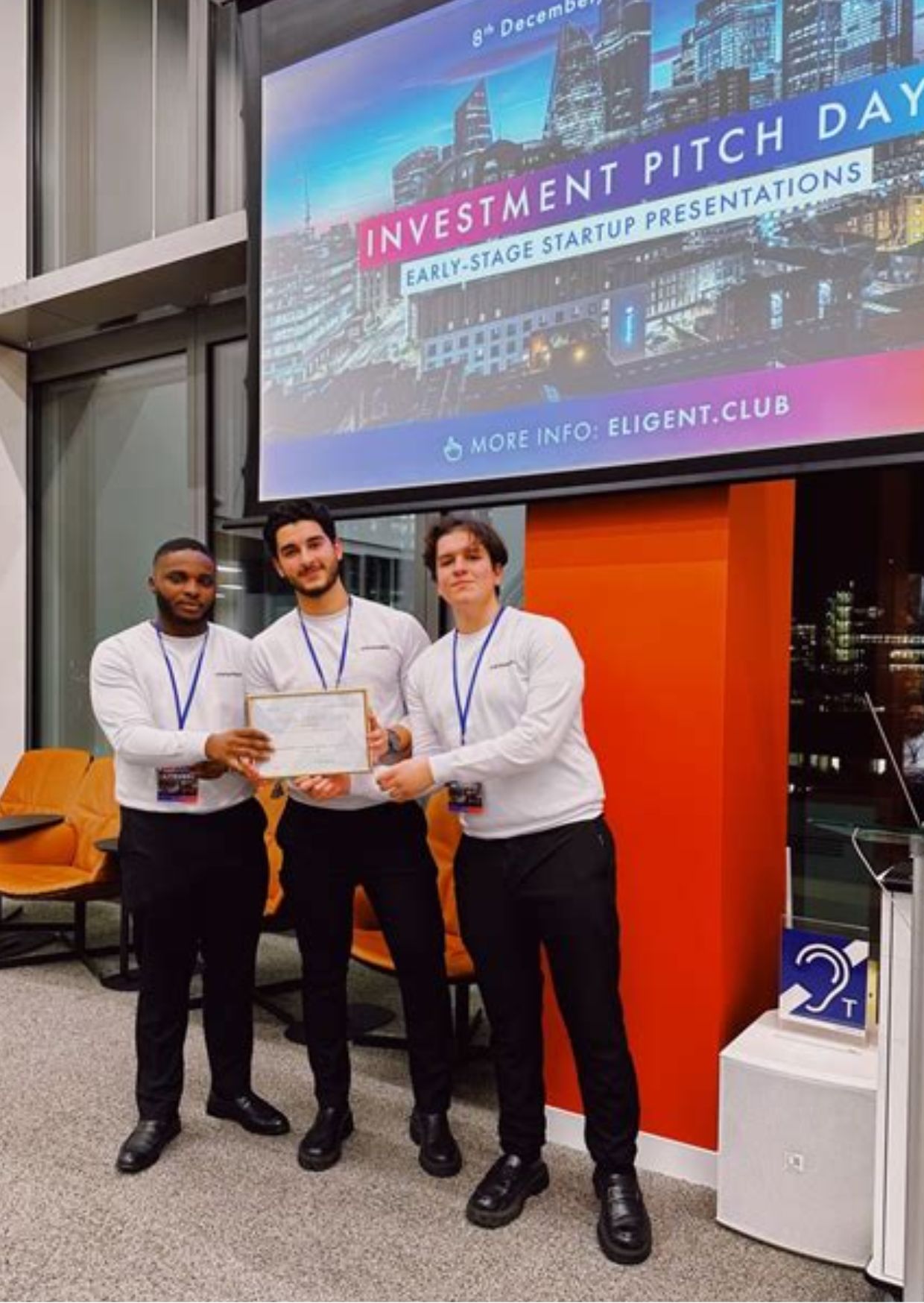
Won 1st place at the ELIGENT Investment Pitch Day in London while representing OnlyFounders. The event brought founders, investors, and entrepreneurs together to pitch startup ideas.

Served as Vice President of Cosmopol ISC, leading teams that welcomed international exchange students and organized cultural events across France and Europe.

I love discovering new cultures, economies, and views through travel, and have visited 31 countries so far.
Coursework spanning data science, international trade, and business strategy, built on a quantitative foundation.
 EDC Paris Business School
In progress, on an apprenticeship track alongside my Product Owner role at The Redesign Group and my prior Marketing Data Analyst role at Maison de Senteurs.
 University of Westminster - study abroad / dual degree
Coursework included Global Trade and Business Project, International Political Economy, International Trade, Strategic Perspectives, Research Methods in Business, and Professional Experience in Global Trade and Business. This is where I completed my dissertation on Brexit's impact on the global automotive industry.
 Yonsei University - Seoul, South Korea
One semester abroad in Seoul, part of what brings the country count in the stats above to four.
 ISC Paris - International Track
The base three-year bachelor's degree behind both the Yonsei exchange and the Westminster dual degree above.
I write an article after finishing each major data project: what I found, what interested me in the sector, and practical read-outs from the industries I study.
A high-level view of how political decisions alter global supply chains, tracking the shift from friction-free trade to new regulatory boundaries in British car manufacturing.
The UK automotive sector changed completely after leaving the European Union. Before Brexit, parts moved across the English Channel with zero paperwork. Factory floors relied on parts arriving exactly when needed. Today, new border checks create delays. Car makers now face tariffs if they do not source their components locally. This shift forces companies to rewrite their logistics playbooks and look for local suppliers to keep factories running.
An industry analysis of the African insurance sector, highlighting the role of regulatory bodies, mobile distribution networks, and workforce demographics.
Insurance works differently across the African continent compared to Western markets. The sector relies heavily on regional networks like FANAF to set standards across French-speaking nations. Traditional insurance models often fail to reach rural populations. Instead, mobile technology drives growth. People buy micro-insurance policies directly through their phones. The major challenge now is building trust and creating diverse teams that understand local consumer habits.
An overview of artificial intelligence in healthcare, focusing on clinical decision support and the partnership between medical staff and automated screening tools.
Artificial intelligence changes how hospitals treat patients. Computer software reads medical scans faster than humans alone. These systems do not replace doctors. Instead, they act as assistants by flagging suspicious dark spots on X-rays early. This helps medical teams prioritize urgent cases. The technology allows clinics to handle larger volumes of patients without losing accuracy, making healthcare more accessible.
A market review of investment behaviors and financial trend tracking within the North African corporate banking sector.
Investment banking in North Africa adapts fast to global economic changes. Institutions like BMCE Capital navigate shifting currencies and local stock trends. Investors look for stability by spreading their capital across different asset classes. Data analysis helps these institutions spot long-term cycles rather than reacting to daily market swings. Success in this market requires a balance between traditional relationship banking and modern data monitoring.
An exploration of political advertising frameworks, campaign behavior, and the legal rules governing voter engagement in Europe.
Political campaigns face strict rules across Europe, especially in countries like Belgium. Unlike the open market in the US, European regulations limit how political parties target voters online. Campaigns cannot simply buy unlimited data to micro-target small groups. They must follow standardized transparency laws. This environment forces parties to change their communication strategy, and focus on broader public issues rather than hidden, hyper-specific digital campaigns.
A study of how consumer software evolves through automated personalization, predictive features, and product design.
Artificial intelligence is no longer a separate feature. It sits inside the everyday applications we use to shop, read, and work. Software platforms use data to predict what users want before they ask. A modern digital bookstore does not just list titles. It analyzes past choices to create a unique storefront for every visitor. This shift turns static applications into active helpers, and changes how businesses engage with customers.
Open to Product, Data Analyst, and Data Strategy opportunities - reach out anytime.